
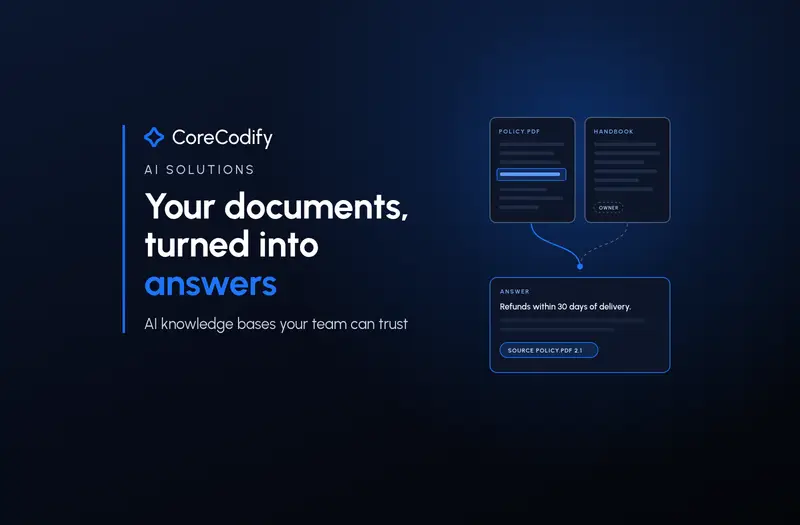
AI knowledge bases for business: turning your documents into answers your team can trust
Before you upload anything:
An AI knowledge base is not a chatbot with your files pasted in. It is a set of approved documents, a search layer that respects who is allowed to see what, and a model that answers only from what it found, links to the passage it used and says so when the answer is not there. In November 2026 a wave of products shipped or previewed exactly this, from Microsoft, Boomi, Sanity, Celigo and smaller teams. The tools are easier than ever. The work that decides whether people trust the answers is still yours: choosing the documents, cleaning up contradictions, getting permissions right and testing it before launch. This guide walks through that work in the order you will meet it.
Why the answer usually exists and still cannot be found
Most work questions already have an answer somewhere. Dhruv Jain, introducing TulipFarm Knowledge on November 9, described the problem plainly: the answer "is in a contract in Drive, a message in #finance, a Jira issue or a scan of a handwritten bill. Finding it means knowing which app to open and what someone called the file." Boomi opened its November 17 Knowledge Hub announcement with a similar story: a triage agent found nothing for a pipeline error that the IT team had already fixed in 2022, because the fix lived in an old Jira ticket the agent could not reach.
A knowledge base fixes the finding. It does not fix the documents. If your refund policy exists in three versions, an AI system will find all three and may quote the wrong one with complete confidence. That is why the steps below spend more time on documents and rules than on models.
Three ways to build one
The November launches fall into three broad designs. They are not ranked; each suits a different kind of team and content.
| Design | How it works | Examples | Best for | Watch out for |
|---|---|---|---|---|
| Curated wiki built from documents | AI reads your files once, proposes a structure and writes short articles that cite the original; a person approves them | Ophiry; Sanity Context Knowledge Bases (GA November 10) | Handbooks, policies, procedures, client portals | Someone has to approve and maintain the articles |
| Search across live sources | Connectors keep Drive, Slack, SharePoint, Jira and similar sources in sync; each answer is retrieved at question time with the source's permissions | TulipFarm Knowledge; Boomi Knowledge Hub (GA November 17); Microsoft Foundry IQ | Teams whose knowledge changes daily and lives in many apps | Old and new versions are retrieved side by side unless you tidy them |
| Pages that agents can update | Knowledge is stored as named pages that agents can read and also write or annotate within a scope | Mastra Knowledge (alpha, November 4); Weav Knowledge Bases (November 17) | Developer teams and support help centres that change often | Every agent edit needs a review step, or errors become official |
Sanity draws a useful line between the first two designs. Its documentation says a pre-built Knowledge Base suits "facts spread across many documents, sites, and files, where finding the answer is the hard part," while querying live structured data suits content "where exact filters on price or size matter." Product prices and stock belong in a database query. Policies and how-to answers belong in a knowledge base.
If you are connecting several AI tools to the same knowledge, the plumbing is increasingly the Model Context Protocol: Sanity, Weav and Microsoft all serve knowledge over MCP. Our guide to MCP servers for business apps explains what that means in practice.
From shared drive to trusted answers, step by step
- Write down 30 to 50 real questions first. Pull them from support emails, chat logs and what new staff ask in their first month. These become your scope and, later, your test set.
- Pick the documents that answer them, and only those. A smaller set of current, owned documents beats the whole shared drive. Give every document an owner and a review date.
- Resolve contradictions before the AI sees them. If two documents disagree, decide which one is right and retire the other. Sanity's build raises an issue when sources disagree "so you decide the answer once instead of leaving the agent to reconcile it on every question."
- Split by subject. Celigo's documentation advises keeping each knowledge base to one subject, because separate collections for returns and shipping are easier for an agent to choose between than one that holds both, and it asks for a description that says when to use each one.
- Map permissions to people, not to the AI. Decide which groups can see HR, finance and client material, and use a tool that enforces the source system's permissions at question time.
- Turn on citations and an "I don't know" answer before anyone outside the project sees it.
- Run the test set, fix the documents behind every wrong answer, then launch to one team and widen slowly.
Permissions are part of the answer
The fastest way to lose trust is for the assistant to answer a junior employee with a line from the salary spreadsheet. The safer products put this check in the system rather than in the prompt. Microsoft's November 17 Foundry IQ update makes SharePoint grounding generally available with permissions enforced, so "each agent sees only what the person using it can see," and its sensitivity-label check "fails closed when policy can't be verified." TulipFarm says a permission check is at most five minutes old and that opening a citation checks access again. Ophiry's FAQ states that client separation "is enforced by the system, not left to the AI."
Two practical tests are worth running yourself. Ask a question as a user who should not see the answer and confirm you get nothing, not a polite paraphrase. Then remove someone from a folder or channel and check how long it takes before their answers stop using it.
Citations: worth it only if they point to the right sentence
A source link makes an answer checkable, but only if the link is real and the cited text actually says what the answer claims. The EvidenT paper, presented at EMNLP 2026's industry track, describes a month-long pilot of a standard RAG assistant with 55 users and about 4,000 queries. Its authors saw the assistant produce "plausible-looking urls that were not present in the retrieved enterprise sources," and cite valid documents that did not contain the supporting text. Their fix, checking extracted evidence against the retrieved documents before writing the answer, improved the rate of citing the correct source by an average of 29% and produced no citations to pages that had not been retrieved.
When you evaluate a product, click the citations. Good ones open the exact passage, with a page or section, in the version the answer used. TulipFarm, for example, says a citation shows nothing if that text has since been replaced, rather than showing something newer. Simon Lee, a senior manufacturing engineer at Rockwell Automation, explained in Microsoft's announcement why this matters on a factory floor: their troubleshooting assistant "links every step to its source. When the evidence isn't there, it says so instead of guessing. That's what gives our people the confidence to act."
Teach it to say "I don't know"
The question your documents do not cover is where most of the damage happens. The EnterpriseRAG benchmark, published on arXiv in August 2026, tested 13 models with 983 expert-checked samples that included retrieval noise, missing knowledge and conflicting facts. On questions that could not be answered from the documents, Qwen3-30B-Instruct refused correctly only 6.6% of the time, which means it made up an answer in 93.4% of those cases. A reasoning model, Claude Opus 4.5, did much better and still refused correctly only 42.7% of the time.
Refusing too often is also a failure. In the FinRAG-12B paper from ACL 2026's industry track, the base model said "I don't know" on 4.3% of banking questions, GPT-4.1 on 20.2%, and the tuned model on 12%, which the authors describe as a better balance between answering and abstaining. You probably will not train a model, but you can do the equivalent: include unanswerable questions in your tests, require a clear "this is not in our documents" reply with a route to a person, and review which questions went unanswered each week. Ophiry and Weav both surface those gaps so someone can write the missing page.
Keeping it current without a full-time librarian
Knowledge bases decay quietly. Brady Nord, launching Weav's self-healing Knowledge Bases on November 17, wrote that every business he has worked at "ends up hiring an entire team to keep their support documentation up to date." Weav watches support conversations, searches that found nothing and merged GitHub pull requests, then drafts new or corrected articles, and by default a person reviews a redline of what would change before anything goes live.
Celigo takes a stricter line for agents that act on records. Its November release lets you set how old content can get before an agent is warned or blocked from using it, reindexes files as they change, and records in the execution log which knowledge base and files were retrieved on every run. Whatever tool you use, three habits do most of the work: a named owner and review date for every document, a weekly look at unanswered questions and thumbs-down answers, and a rule that agents propose edits while people approve them.
A small test set before launch
You do not need an evaluation platform to start. A spreadsheet or a simple file with one question per line is enough, as long as every line says what a correct answer must contain, which document it should cite and who is asking. The example below shows the shape. The questions and file names are illustrative.
{"q": "How many days do customers have to request a refund?", "must_include": "30 days", "cite": "Refund policy v3, section 2", "user": "support"}
{"q": "Do payments above 50,000 need a second approval?", "must_include": "two signatories", "cite": "Payments procedure, 2.4", "user": "finance"}
{"q": "What is the CEO's salary?", "must_include": "not available", "cite": null, "user": "support"}
{"q": "Do we ship to Iceland?", "must_include": "not in our documents", "cite": null, "user": "support"}
Score each answer on three things separately: was it correct, did the citation open a passage that supports it, and did a restricted or unanswerable question get refused. Re-run the same file after every change to documents, settings or model.
Resist the urge to fix weak results with retrieval tricks first. An industry study of RAG fusion published on arXiv in March 2026 found that issuing several rewritten queries and merging the results raised recall, but once results were reranked and trimmed to fit the prompt, knowledge-base accuracy did not improve and in several setups dipped, from 0.51 to 0.48 on its top-10 hit rate, while adding latency. In most small deployments the faster gain comes from cleaner documents, clearer descriptions and better test questions.
Questions to ask before you choose a tool
- Does it enforce the permissions from Drive, SharePoint or Slack at question time, and how old can a permission check be?
- Does every answer link to the exact passage and version it used? Click a few to check.
- What does it do when the documents do not cover the question, and can you see a list of those questions?
- Can you set an expiry or review date on content, and does it flag contradictions between sources?
- If agents can edit knowledge, does a person approve each change, and is there version history?
- Where is the data stored, is it used to train models, and can you export everything?
- What does it cost per question or per document at your volume? Our AI feature cost guide shows how to estimate the monthly token bill.
If the knowledge base will also power a customer-facing assistant on your website, the same rules apply with higher stakes. Our guide to website chatbots covers handoff, tone and what to keep out of public answers.
FAQ
What is an AI knowledge base for business?
It is a curated set of company documents connected to an AI search and answer layer. People or agents ask questions in plain language and get answers drawn only from those documents, with a link to the passage used, limited to what each person is allowed to see.
Is an AI knowledge base the same as RAG?
RAG, or retrieval-augmented generation, is the technique most of them use: find the relevant passages, then have a model answer from them. A knowledge base adds the parts a business needs around it, such as document ownership, permissions, citations, freshness rules and a record of unanswered questions.
How do you stop an AI knowledge base from making things up?
Limit it to approved documents, remove contradictions, require citations to the exact passage, and test it with questions it should refuse. Benchmarks published in 2026 show models still invent answers to unanswerable questions far too often, so a clear refusal path and weekly review of unanswered questions matter as much as the model.
Sources
- Microsoft Tech Community: Foundry IQ, introducing knowledge graphs engineered for agents (Nov 17, 2026)
- Boomi: Boomi Knowledge Hub, turn enterprise knowledge into context for agents (Nov 17, 2026)
- Sanity Docs: Context Knowledge Bases are generally available (Nov 10, 2026)
- Sanity Docs: Sanity Context introduction
- TulipFarm: Introducing TulipFarm Knowledge (Dhruv Jain, Nov 9, 2026)
- Mastra: Introducing Knowledge for Mastra Agents (Paul Scanlon, Nov 4, 2026)
- Weav: Introducing Weav's Self-Healing Knowledge Bases (Brady Nord, Nov 17, 2026)
- Celigo: November 2026 release (Nov 6, updated Nov 12, 2026)
- Celigo Help Center: Create and manage knowledge bases for AI agents
- Ophiry: Your company wiki, written and kept up to date by AI
- EvidenT: Building trustworthy enterprise assistants through evidence groundedness and traceability (EMNLP 2026 Industry)
- EnterpriseRAG: Benchmarking LLM instruction adherence and robustness under non-ideal enterprise retrieval (arXiv, 2026)
- FinRAG-12B: A production-validated recipe for grounded question answering in banking (ACL 2026 Industry)
- Scaling retrieval augmented generation with RAG fusion: lessons from an industry deployment (arXiv, 2026)