
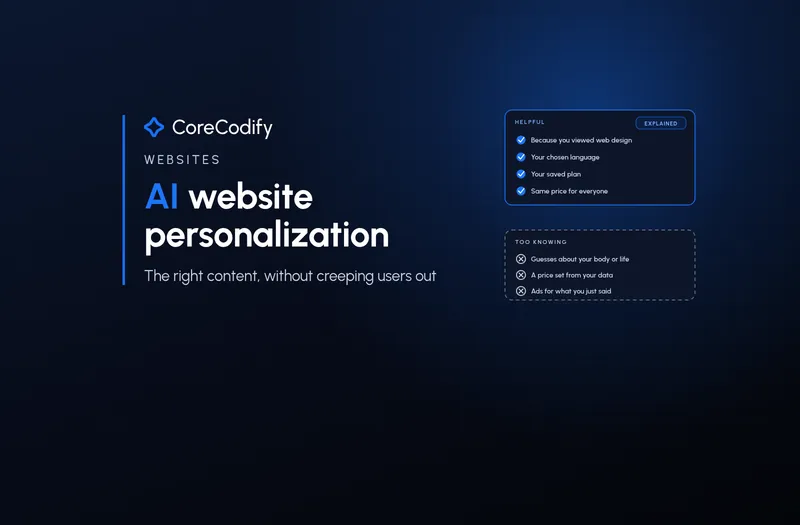
AI website personalization: showing the right content without creeping users out
Quick Go-Through:
AI has made website personalization cheap. A year ago, showing a different hero, offer or set of articles to each type of visitor meant writing every version by hand and wiring up a testing tool. In October and November 2026, several tools started writing those versions for you from the pages you already have. The hard part is no longer building personalization. It is deciding how much a website should show that it knows, and where helpful turns into unsettling. This guide looks at what launched, what went wrong in public, what the new pricing rules say, and how to personalise a site so visitors feel understood rather than watched.
Why this matters now
Visitors still want sites to recognise them. In research Amperity published through the CDP Institute in September 2026, 72.3% of consumers said personalized experiences are important when choosing a brand, and half said they are more loyal to brands that show they know them. The same survey shows how often it goes wrong: only 15% said the offers and recommendations they receive are often genuinely relevant, and 57.5% said they pull away from personalization that feels invasive or creepy.
Those two numbers describe the job. Personalization that is relevant earns attention, and personalization that is wrong, repetitive or too revealing costs it. AI makes it easier to produce more versions faster, which helps only if the data underneath is accurate and the rules about what to show are clear.
What launched in October and November 2026
On 1 November, Personyze described six AI setups that read a site, its products or its articles and build personalized parts for each visitor: page versions for each audience, product and content recommendations, reviews, promotions and a chat that answers from the site. The rules it lists are the interesting part. A page version that adds a number, a price, a name or a claim the original page does not make is dropped, real reviews are never rewritten, promotions stay drafts until a person approves them, and a share of each segment keeps seeing the original page so every version is measured against it.
On 4 November, Dotdigital put its SmartBlock agent into public preview, letting marketers describe a personalized web block, such as a banner, product recommendations or a coupon, and have the agent build the layout, copy and styling from the brand's details. Userled's Content Agent can now take a live page or Figma file, rebuild it as editable blocks in under 30 seconds and turn one asset into 10, 50 or 100 versions for different accounts, industries or languages, with every version editable and approved before it goes live.
Two other launches show where this is heading. On 5 November, the Frankfurt consultancy statworx introduced Generative Site Search, which assembles a page for each visitor's question instead of returning a chatbot reply, and which draws only on content already on its own website to reduce the risk of hallucinations. Contentsquare announced a new experience platform on 13 October whose Sense agent can form test hypotheses, build and launch experiments and measure revenue impact, with the company saying Sense "can run this loop end to end" and "all you need to do is approve." Across all of these, the pattern is the same: AI writes the versions, and a person still decides what reaches visitors.
The creepy line, shown in public
In early October, Amazon's About You page went viral. The page, launched on 13 May, lists what Amazon has inferred about a shopper from purchase history, searches, saved lists, product reviews and conversations with its Alexa for Shopping assistant, and lets the shopper edit or remove each item. When Amazon launched it, the company wrote: "Understanding your preferences is fundamental to providing you with high-quality, relevant recommendations." Once shoppers started posting their pages on Threads, the inferences got the attention instead. As The Next Web summarised, one user found Amazon had concluded she "has flat buttocks", and others found entries such as "has no friends" and "cannot keep real plants alive".
Business Insider reported that Amazon says it does not collect any information from third parties for About You, and its own newsroom found the conclusions were sometimes acutely accurate and sometimes dead wrong. The lesson for a smaller site is not that inference is bad. Most entries were ordinary and correct. The lesson is that a guess about a person reads very differently from a product suggestion. "Customers who bought this also bought" feels normal. A sentence describing someone's body, relationships or habits feels like surveillance, even when the same data produced both.
Older survey data points the same way. In Contentstack's Fall 2025 personalization report of more than 600 US and UK shoppers, 64% said they had experienced personalization that felt too invasive or creepy. The most cited reason, from 70% of them, was seeing an ad for something they had just been talking about, followed by brands following up too often (51%) and ads based on real-time location (36%). Those are all moments where a brand revealed a signal the visitor did not expect it to have.
Personalized pricing is now a legal question
The clearest line is around price. On 28 October, the US Federal Trade Commission ordered nine companies, including Walmart, Target, Uber, DoorDash, Instacart and three airlines, to explain whether and how personal data shapes the prices people pay. FTC Chairman Andrew Ferguson said, as quoted by the IAPP: "Consumers deserve to know whether companies use their web surfing habits or other personal data to estimate the highest price they can charge each consumer." The orders are a study, not an enforcement action, but the FTC's proposed policy statement from August says personalized pricing without adequate disclosures likely violates Section 5 of the FTC Act.
States have gone further. New York requires a label near any price set this way that reads "THIS PRICE WAS SET BY AN ALGORITHM USING YOUR PERSONAL DATA." Maryland's ban on certain grocery and delivery providers using personal data to set prices took effect on 1 October 2026, and Connecticut and New Jersey bans follow in July and August 2027, according to Sidley Austin's October review. At the IAPP's privacy conference in October, Bryan Cave Leighton Paisner partner Goli Mahdavi explained what changed: "What has changed is not the existence of variable pricing but the technology behind it." The panel's advice for businesses was to "say what you do and do what you say."
For most websites, the safe practical rule is simple: personalise what people see, not what they pay. Showing a returning customer the category they browse most is ordinary. Quietly changing the price because of who someone appears to be is the kind of personalization regulators are now looking at.
What good personalization looks like
Good personalization uses signals the visitor knowingly gave: what they searched for on your site, the category they clicked, the language they chose, the plan they are on, or a preference they set. It changes order and emphasis, such as which case study appears first or which help article is suggested, more often than it changes facts. It never invents a claim, a discount or a deadline the business does not offer, which is exactly why the Personyze-style rule of dropping any version that adds unverified numbers or claims is worth copying in any tool you use.
It also explains itself. UXExpert founder Tushar Deshmukh argued in UX Magazine on 3 November that the test of success is a user who, if shown exactly how a recommendation was generated, would still consider the exchange fair, and he quotes Think Design Collaborative CEO Deepali Saini: "Every smart interaction is also a design decision about power." A small line such as "Because you viewed web design projects" costs nothing to add and turns a guess into a visible, correctable choice. Amazon's About You page, for all the jokes, does one thing right here: it lets people see and remove what is being used.
Finally, it is measured against a version with no personalization. Contentsquare's 30 October guide on AI personalization and experimentation puts the goal plainly: AI personalization and experimentation should "show each user the right content and prove what works." If a personalized hero does not beat the plain one for a segment, the simpler page is the better page.
An eight-point checklist before you personalise with AI
- Write down every signal you plan to use and ask, for each one, whether a visitor would expect your site to know it. Drop the ones they would not.
- Personalise layout, order and suggestions first. Leave prices, legal terms and core claims the same for everyone unless you are prepared to disclose why they differ.
- Never describe the visitor back to them. Recommend things; do not state conclusions about their body, health, finances, relationships or beliefs.
- Require every AI-written version to use only facts already on your site, and reject any version that adds a number, price, name, discount or deadline.
- Keep a person approving each version before it goes live, and keep a holdout group that sees the original page so you can measure real lift.
- Add a short plain-language reason next to personalized blocks, and give visitors a way to reset or turn off personalization.
- Respect consent: no personalization from tracking data a visitor declined in your cookie banner, and keep your privacy notice in line with what the site actually does.
- Review the experience every month as a new visitor, a returning customer and a logged-in user, and remove anything that feels repetitive or too knowing.
Where CoreCodify fits
AI website personalization works best when it is modest: a few well-chosen changes, based on signals visitors understand, with facts that never change behind their backs. The tools launched this autumn make it faster to build those versions, but the decisions about what to use, what to show and what to leave alone still belong to the business.
At CoreCodify we design and build custom websites and apps with AI features scoped to what the technology really does, including personalized sections grounded in your own content, clear explanations for visitors, consent-aware tracking and proper A/B testing. If you want your site to feel more relevant without crossing the creepy line, hire me for custom work at usamify.com.
Sources
- CDP Institute / Amperity: How Generative AI Is Changing Brand Discovery, and Who Earns the Second Purchase (Sep 21, 2026)
- Personyze: Build a Personalized Website With AI, Setup by Setup (Nov 1, 2026)
- Dotdigital: 4 November 2026 Personalization release notes (SmartBlock agent public preview)
- Userled: Your best page, rebuilt for every account in 30 seconds (Content Agent)
- PR Newswire: statworx introduces Generative Site Search (Nov 5, 2026)
- Contentsquare: New AI-first Experience Platform announcement (Oct 13, 2026)
- The Next Web: Amazon's About You page goes viral for what it guesses about shoppers (Oct 7, 2026)
- Business Insider: Amazon About You dossier, what data it uses and how to edit it (Oct 2026)
- Contentstack: Personalization, privacy and AI in digital commerce FAQ (Fall 2025 report)
- IAPP: FTC expands personalized pricing scrutiny as states, Congress, regulators turn up pressure (Oct 29, 2026)
- CNBC: FTC demands Walmart and others hand over data on personalized pricing (Oct 28, 2026)
- Alex Proctor: Surveillance pricing laws taking effect, what do they require
- Sidley Austin: From Disclosures to Prohibitions, the new legal landscape on personalized pricing (Oct 2026)
- UX Magazine: The Personalization Trap (Tushar Deshmukh, Nov 3, 2026)
- Contentsquare: How to use AI in website personalization and experimentation (Oct 30, 2026)