
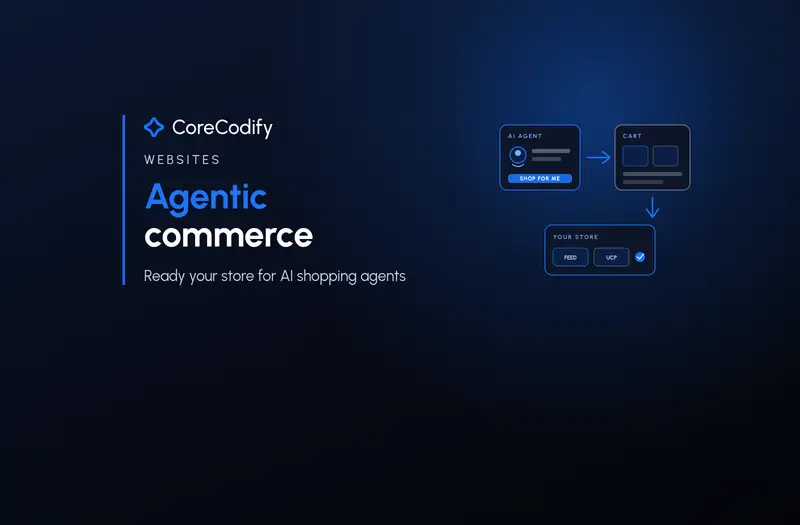
Agentic commerce: getting your online store ready for AI shopping agents
Quick Go-Through:
Online shopping is no longer only tabs, search boxes and cart pages. In late 2026, shoppers can ask an AI assistant to find a product, compare options and, on more surfaces every week, finish the purchase without opening your homepage first. That pattern is agentic commerce: AI agents that help people discover, evaluate and buy, with the shopper still deciding how much control to hand over. For a store owner the useful question is not whether demos look impressive. It is whether your product data, checkout rules, policies and agent-access choices are ready when an assistant sends a buyer your way, or when a retailer-side gateway tries to buy on their behalf.
What agentic commerce is, and who can check out now
Agentic commerce means an AI agent takes a stated intent (a gift under a budget, a restock of usuals, a comparison across brands) and helps complete some or all of the path to purchase. The category is not one product. Google, Microsoft, Meta and Perplexity have offered checkout inside the chat for U.S. shoppers; ChatGPT shifted toward merchant checkout and retailer apps after March 2026; Amazon runs its own shopping agents and blocks outside ones; Walmart opened a supervised door for approved agents in October.
Shopify describes the same shift for merchants: agents surface products from structured catalogs, then checkout runs through Shopify Checkout or a merchant-controlled flow, with the merchant remaining merchant of record. Co-developed with Google, the Universal Commerce Protocol (UCP) is the open standard meant to keep cart, payment and post-purchase rules consistent across AI surfaces instead of one custom integration per assistant.
Google UCP checkout expands in Canada on 4 November
On 4 November 2026 Google Canada announced that direct checkout powered by UCP is expanding to Canadian shoppers on AI Mode in Google Search and the Gemini app. Eligible retailers at launch include lululemon, select Shopify merchants, Shoppers Drug Mart and Simons. Shoppers can buy with Google Pay using methods and shipping details already in Google Wallet. Retailers remain the seller of record and can customise the integration. Google says simplified UCP integration will open in Merchant Center starting next year so more retailers can enable direct checkout from their accounts.
The same post reports that 59% of holiday shoppers in Canada plan to use an AI tool to help them shop this season, and frames agentic commerce as helping shoppers act at the moment of intent rather than juggling tabs until the cart is abandoned. Two weeks earlier, on 15 October 2026, Google launched Universal Cart in the U.S. across Search and the Gemini app: one cart for items from multiple retailers, price-drop and restock alerts, promo and card-perk hints via Google Wallet, and checkout with Google Pay or a transfer into the merchant's own cart. Named merchants include Nike, Sephora, Target, Ulta Beauty, Walmart, Wayfair and many Shopify stores, with the merchant still seller of record either way.
Walmart opens an Agent Gateway; Amazon blocks outside agents
On 21 October 2026 Walmart announced Agent Profiles, the Walmart Agent Gateway and published terms for AI agents on Walmart and Sam's Club. Agent Profiles give each authorised agent a dedicated profile inside the customer's account so agent purchases are visible separately. Customers can require approval for every purchase or set a spending limit, with $50, $100 or $200 given as examples. The Agent Gateway is built for agents over MCP rather than brittle browser clicking, starts as a beta for companies and developers, and can help an agent fetch a customer's usuals without handing the agent the full purchase history. Agents do not receive payment-card information and cannot add or change payment methods; Walmart's returns process still applies, including when an agent does not act as intended; non-compliant agents are blocked.
TechCrunch noted the contrast the same day: Amazon has been blocking outside AI agents from buying on behalf of shoppers, while Walmart is rolling out a supervised welcome mat, building on earlier conversational integrations with Muse, ChatGPT, Gemini and others. EPR's landscape update (2 November 2026) summarises the wider split: Google AI Mode/Gemini and Copilot/Perplexity/Meta Muse support in-chat checkout paths for U.S. shoppers; ChatGPT focuses on discovery with merchant checkout or retailer apps after the 24 March 2026 change; Amazon Alexa for Shopping and Buy for Me stay closed to outside agents. Daniel Danker, Walmart's EVP of AI acceleration, product and design, earlier told WIRED that Instant Checkout purchases inside ChatGPT converted three times worse than click-outs to Walmart's site — a reminder that in-chat checkout is not automatically better conversion, even when it is technically possible.
Trust still caps full autonomous buying
Willingness to let AI finish the decision is still low. A Gartner survey of 322 U.S. consumers in January 2026 found that willingness to let AI make purchase decisions topped out at 11% across lower-stakes categories such as personal care and household supplies. Openness was higher for narrowing choices: 31% for household supplies and 28% for personal electronics. Kate Muhl, VP Analyst in the Gartner Marketing practice, said: "Consumers are not looking to outsource shopping decisions to AI. They want AI to help them find better information, compare prices, identify deals and narrow choices, while keeping final decision-making control for themselves."
A separate Gartner survey of 846 U.S. consumers (November–December 2025) found that among people who used AI while shopping for a recent purchase, 54% had to double-check the accuracy of GenAI information and 62% said GenAI shopping information was a waste of their time. Muhl's follow-up is blunt for brands: accuracy is now a brand issue. If AI tools create more verification work, shoppers will not treat them as convenient. For your store that means clean, current product facts matter more than a flashy agent demo — wrong price, stock or shipping in a feed becomes a trust failure in the assistant before the buyer ever sees your homepage.
What your online store must have ready
Agents do not browse the way people do. They read structured product data: titles, attributes, images, live price, inventory, shipping and return terms. Shopify Catalog syndicates that data to connected AI channels and keeps the merchant as merchant of record when checkout runs through Shopify. Google checkout eligibility runs through Merchant Center and UCP. If GTIN, price, stock and policy text disagree between your feed and your product page, assistants will either skip you or recommend something you cannot honour.
Add Schema.org Product markup that matches the feed, keep guest checkout and promo codes working on mobile (ChatGPT often opens the merchant store in an in-app browser), publish clear return and refund rules that still apply when an agent placed the order, and write an agent-access policy: which assistants may buy, what you do when Amazon-style blocking is required, and who owns support when an agent-ordered item is wrong. Segment AI referrals in analytics so you can see which surfaces send buyers before Black Friday volume hits.
An eight-point agentic commerce checklist
- Audit product feeds and on-page data so price, stock, GTIN, shipping and returns match everywhere an agent can read them.
- Add and validate Schema.org Product markup; fix Merchant Center and catalog errors before you chase new AI channels.
- Decide which surfaces you join on purpose: Google UCP / AI Mode, Copilot, ChatGPT discovery, Shopify Agentic Storefronts, or retailer apps.
- Keep yourself merchant of record wherever the protocol allows, and test Google Pay or cart-transfer flows on a phone.
- Publish an agent-access policy: allowed agents, spending or approval expectations, and what happens when an agent misbehaves.
- Make returns, refunds and support work for agent-placed orders so chargebacks do not become the default escape hatch.
- Optimise for research and comparison first (the behaviour Gartner says shoppers actually want), not fully autonomous checkout theatre.
- Measure AI referrals separately and re-test checkout from inside each assistant before peak holiday traffic.
Where CoreCodify fits
Agentic commerce is moving from demos into merchant tooling: Google's UCP rollout in Canada, Universal Cart in the U.S., Walmart's Agent Gateway and Shopify's Agentic Storefronts all assume the same foundation — accurate product data, predictable checkout and clear policies. Trust research still says shoppers want help narrowing choices, not a bot that spends their money unsupervised. Stores that treat feeds, schema and agent rules as website work will be ready when the next assistant turns intent into an order.
At CoreCodify we build custom websites and ecommerce experiences with clean product data, structured markup and checkout flows that hold up when traffic arrives from AI surfaces, not only from search ads. If you want an online store prepared for agentic commerce rather than patched after the first failed agent order, hire me for custom work at usamify.com.
Sources
- Google Canada Blog: A new way to shop — agentic shopping and UCP checkout in Canada (Nov 4, 2026)
- Google Blog: Universal Cart launches in the U.S. (Oct 15, 2026)
- Walmart Corporate: Making It Possible for Agents to Shop on Behalf of Customers (Oct 21, 2026)
- TechCrunch: While Amazon blocks AI agents, Walmart rolls out the welcome mat (Oct 21, 2026)
- Gartner: Consumers want AI shopping help, but not AI purchase decisions (May 27, 2026)
- Shopify Blog: Agentic Commerce on Shopify — How It Works (updated Jun 18, 2026)
- Shopify: Universal Commerce Protocol (UCP)
- EPR: Agentic Commerce — which AI assistants can check out now (updated Nov 2, 2026)
- Search Engine Land: Walmart — ChatGPT checkout converted 3x worse than website (Mar 19, 2026)
- WIRED: Why Walmart and OpenAI are shaking up their agentic shopping deal (Daniel Danker on Instant Checkout)
- The Verge: Google launches its universal online shopping cart (Oct 15, 2026)
- Search Engine Journal: Google Universal Cart is live — how carts get to your store (Oct 15, 2026)