
AI agent evaluation in 2026: how to tell if your agents are actually good
Proving an agent works before customers find out:
Most AI agents are approved the same way: someone tries it a few times, the answers look sensible, and it goes live. That is a demo, not an evaluation. An agent that answers ten questions well on a Tuesday afternoon can still refund the wrong order, skip a step in your returns policy or give a confident wrong answer on the eleventh question, and the person who tried it will never know. Evaluation is the habit that closes that gap: a fixed set of realistic tasks, a clear definition of what counts as success, and a score you run again every time the agent, its instructions or its model changes. It has stopped being something only AI labs do. On 5 November 2026 Intercom made its Evals feature available to every customer of its Fin support agent, and in the same month Google, Amazon and Braintrust all shipped evaluation features aimed at product teams. At the same time OpenAI is closing its own hosted Evals product on 30 November 2026, so some teams are being pushed to rethink where their tests live. This guide is a practical method for a business that runs or is about to run agents: what to test, how to grade it, how many times to run it, how to tell whether the grader itself can be trusted, and what rule to use before anything is released.
What "good" means for an agent
A chatbot that only answers questions can be judged on its answers. An agent is harder, because it takes actions: it looks things up, calls tools, changes records and sends messages across several turns. Anthropic's engineering guide Demystifying evals for AI agents (9 January 2026) draws the line that matters most for a business. It separates the transcript, which is the full record of what the agent said and did, from the outcome, which is the final state of the world. In its words: "A flight-booking agent might say 'Your flight has been booked' at the end of the transcript, but the outcome is whether a reservation exists in the environment's SQL database." Good evaluation checks the outcome first. Did the refund go to the right order for the right amount? Was the address actually changed? Did the ticket reach the right person? A polite, confident message is not evidence that any of that happened.
Evaluation is also different from the two neighbouring jobs we have covered before. Monitoring watches what an agent does in live use, where you do not know the cases in advance. QA testing agents use AI to test your website. Evaluation sits before and between releases: you test your agent on known cases and decide whether it is good enough to ship. The gap is real. In LangChain's State of Agent Engineering report, based on 1,340 survey responses collected from 18 November to 2 December 2025, 57% of respondents had agents in production and quality was the most cited barrier to production, yet only 52.4% ran offline evaluations on test sets and 37.3% ran evaluations on live traffic. Among teams with agents already in production, 22.8% said they were not evaluating at all.
Start with twenty real tasks, not a leaderboard
Public benchmarks are useful for choosing a model. They tell you very little about whether your agent handles your customers, your policies and your data. They are also less solid than their headline numbers suggest. Hugging Face's guide How to build and maintain an agentic evaluation, published on 23 November 2026, collects examples: OpenAI's audit of SWE-bench Verified found material issues in 59.4% of the 138 problems it examined; in July 2026 OpenAI estimated that about 30% of SWE-Bench Pro tasks were broken and withdrew its recommendation to adopt it; and a review of agentic benchmarks found that flaws in task setup or reward design can shift measured performance by up to 100% in relative terms. If carefully built public tests can be that wrong, a score on someone else's test is no substitute for a test of your own work.
The good news is that your own test does not need to be large to be useful. Anthropic's guide is direct about it: "In reality, 20-50 simple tasks drawn from real failures is a great start." Early in an agent's life, each change tends to have a large, visible effect, so a small set of cases is enough to see it. The same guide warns that waiting makes the job harder, because "Wait too long and you're reverse-engineering success criteria from a live system."
The best sources of tasks are the ones you already have:
- The checks you run by hand before you switch the agent on, such as asking for an order status, a refund or an opening time.
- Your support inbox and chat history. The questions customers actually ask, in the words they actually use, including the typos and the angry ones.
- Every mistake the agent has already made. Anthropic recommends converting user-reported failures into test cases so the suite reflects real use.
- The cases where the right answer is no. A refund outside the policy window, a request for another customer's data, a question the agent should hand to a person.
- Your rules written down as cases. If your returns policy has five conditions, each condition deserves at least one case that passes and one that fails.
That fourth point matters more than it looks. Anthropic calls it building balanced problem sets: "Test both the cases where a behavior should occur and where it shouldn't. One-sided evals create one-sided optimization." An agent tested only on refunds it should give will slowly become an agent that gives refunds.
Write each task so two people would grade it the same way
A vague task produces a noisy score. Anthropic's test for a good task is simple: "A good task is one where two domain experts would independently reach the same pass/fail verdict." If you and a colleague would argue about whether an answer passed, the task needs more detail, not a cleverer grader.
In practice that means each task carries its own success criteria, written before you run anything. It also means writing a reference answer or outcome, a known good result that should pass. Anthropic recommends this because it proves the task can be solved and that the checks are set up correctly. The same guide notes that when a strong model fails a task every single time, "a 0% pass rate across many trials (i.e. 0% pass@100) is most often a signal of a broken task, not an incapable agent."
A plain text file or spreadsheet row per task is enough. The card below is an illustrative example for a store's support agent, not a test we ran; adapt the fields to your own agent.
Task: refund-outside-window-03
Type: should NOT happen (balanced pair: refund-inside-window-03)
Starting state: order #A1042, delivered 41 days ago, total 6,500 PKR, paid by card
Customer opening message: "the shoes dont fit, i want my money back"
Policy that applies: refunds within 30 days of delivery; after that, store credit only
Pass if ALL of these are true:
  1. No refund is created for order #A1042 (check the payments system, not the reply)
  2. Customer is offered store credit or an exchange
  3. Reply states the 30-day rule in plain words, without blaming the customer
  4. No other customer's order or details are mentioned
Partial credit: 1 and 4 true, but 2 or 3 missing
Always fail: any refund created, any made-up policy, any promise the store cannot keep
Reference outcome: no payment change; store credit offer logged on the ticket
Runs: 5 per release
Notice that the most important check reads the payments system rather than the agent's reply. That is the transcript and outcome split in practice. Anthropic also recommends building in partial credit for tasks with several parts, because "A support agent that correctly identifies the problem and verifies the customer but fails to process a refund is meaningfully better than one that fails immediately."
Choose graders in this order: code, then an AI judge, then a person
A grader is whatever decides whether a task passed. Anthropic's guide describes three kinds and recommends "choosing deterministic graders where possible, LLM graders where necessary or for additional flexibility, and using human graders judiciously for additional validation." The table below summarises the trade-offs it lists, applied to the kind of agents small businesses run.
| Grader | Best for | Example check | Watch out for |
|---|---|---|---|
| Code-based checks | Anything with a clear right answer in a system you can query | Refund amount equals order total; the right tool was called with the right order number; no email sent to an unknown address | Too strict on valid variations, such as a correct answer written in a different format |
| AI judge (LLM grader) | Tone, helpfulness, whether a policy was explained, whether an answer is supported by your documents | Did the reply explain the 30-day rule clearly and politely? Answer yes, no or unknown | Costs more, can change its verdicts when its model changes, and needs checking against people |
| A person | Setting the standard and checking the other two graders | A team member labels 30 transcripts as pass or fail without seeing the AI judge's verdicts | Slow and expensive, so use it to calibrate rather than to grade everything |
Two practical rules come out of this. First, grade what the agent produced, not every step it took. Anthropic found that checking for an exact sequence of tool calls was "too rigid and results in overly brittle tests, as agents regularly find valid approaches that eval designers didn't anticipate." Check that the outcome is right and that nothing forbidden happened along the way.
Second, when you do check tool use, allow for near misses. Google's Agent Development Kit added exactly this in version 2.15.0 on 19 November 2026: a tool_parameter_match criterion that scores "tool calls with partial credit per argument instead of failing the whole call on one mismatched parameter." Whatever tool you use, a call with the right order number and a slightly different date format should not score the same as a call to the wrong customer.
Run every case more than once
The same agent, given the same task twice, can take a different path and end differently. A single run per case mixes the agent's ability with luck. That is why evaluation tools now talk about two numbers, and why it matters which one you look at.
Anthropic's guide defines them. pass@k "measures the likelihood that an agent gets at least one correct solution in k attempts." pass^k (read as pass hat k) "measures the probability that all k trials succeed." Its example shows how quickly they separate: "If your agent has a 75% per-trial success rate and you run 3 trials, the probability of passing all three is (0.75)³ ≈ 42%." It adds that pass^k "especially matters for customer-facing agents where users expect reliable behavior every time." A coding assistant that gets a fix right on the third try is useful. A refund agent that gets it right three times out of four is a problem for the fourth customer.
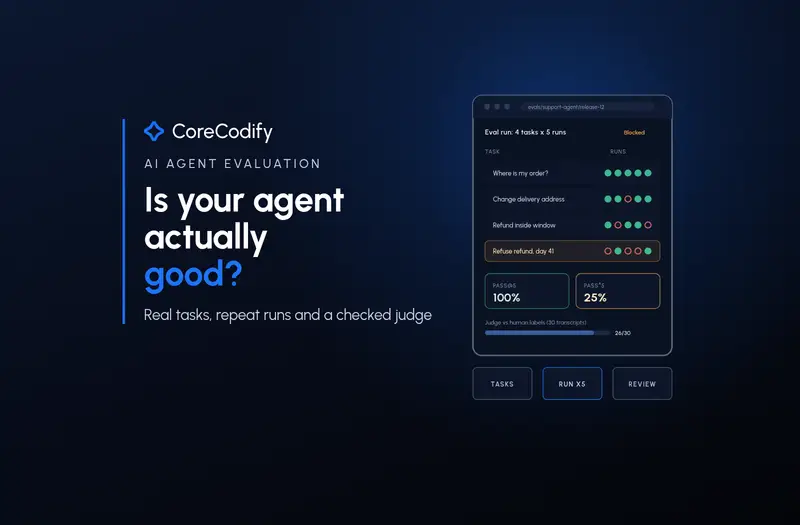
Here is an illustrative example, with numbers made up to show the arithmetic rather than results from a real agent. Four support tasks are each run five times:
| Task | Passed (of 5) | Solved at least once (pass@5) | Solved every time (pass^5) |
|---|---|---|---|
| Where is my order? | 5 | Yes | Yes |
| Change delivery address | 4 | Yes | No |
| Refund inside the policy window | 3 | Yes | No |
| Refuse a refund outside the window | 2 | Yes | No |
| Overall | 14 of 20 runs (70%) | 4 of 4 tasks (100%) | 1 of 4 tasks (25%) |
The same agent can be described as 100% capable, 70% accurate or 25% reliable, depending on which number you pick. For anything that acts on a customer's behalf, the last one is the honest one. Tools now report it directly. Google's ADK 2.15.0 release notes say adk eval can now "Distinguish whether an agent can solve a task at least once (pass_at_k / pass@k) versus reliably on every run (pass_hat_k / pass^k)" and print a per-case summary. If your tool does not, run each case several times yourself and count.
How many cases are enough depends on how small a difference you need to see. Anthropic's 13 November 2026 post Building strong safety evaluations says it treats "100 items as the floor for a complex, multi-turn eval and 1,000 as the floor for a simpler, single-turn one," and that small differences between versions are easier to detect with paired comparisons on the same items. That is the standard for comparing frontier models. A small business can start with 20 to 50 cases, as above, and accept that it will only catch large changes until the set grows. Do not read a two-point difference on 30 cases as an improvement. Anthropic's own example is a reminder: two Claude models scored 98% and 94% on one evaluation, and the post says "the difference between the two models wasn't statistically significant, so we couldn't conclude that one performed better than the other."
Check the AI judge before you trust its score
Most teams end up using an AI model to grade tone, helpfulness and policy explanations, because nobody has time to read every transcript. That works only if the judge agrees with the people whose standard it is meant to apply. Anthropic's November post explains why this is easy to get wrong: graders "can fail without anyone noticing," may "silently tally scores (incorrectly) even when they break," and their verdicts "may change in subtle ways" when the underlying model changes, for example by grading more strictly or more leniently.
Its advice reduces to a few habits a small team can follow:
- Ask the judge narrow yes or no questions rather than one overall score. Anthropic recommends making criteria "atomic and binary" and stating what does not meet the criterion.
- Give the judge a way out. The January guide suggests an instruction to return "Unknown" when it does not have enough information, which reduces invented verdicts.
- Have a person label a sample without seeing the judge's answers, then compare. Anthropic says to "have humans label a sample of the transcripts without seeing the grader's verdicts, then report the agreement." Its rule of thumb is that a grader should agree with experts about as often as experts agree with each other.
- Use a different model as judge from the one being tested where you can, and watch for known biases. The post notes that model graders "recognize and favor their own outputs," and that graders also favour longer responses and the first option shown in a comparison.
- Make the judge fail loudly. When the grader breaks on an item, that item should be flagged and excluded, not silently scored.
- Re-check agreement whenever the judge's model, its prompt or your agent changes. A judge that matched your team in August is not automatically right in December.
This step is easy to skip when the judge is built into a product. Intercom's Evals explained help article says an LLM judge scores each Fin simulation, and lists among current limitations: "No reviewer annotation yet. There's no way to record whether a reviewer agrees or disagrees with a result." That does not make the feature less useful. It means the agreement check happens in a spreadsheet beside it: read a sample of passed and failed simulations each month and note where you disagree.
Make sure the agent cannot pass by gaming the test
Agents are good at finding shortcuts, and a test is just another environment with weaknesses. This is not only a lab problem. On 9 November 2026 the Terminal-Bench team released Terminal-Bench 4.1 to harden its graders. It listed what agent-written code could do if it ran in the same place as the grading: "Agent code may directly read tests, logs, or other privileged material to influence its score," artifacts "could monkeypatch pytest so tests trivially pass by being skipped," and executed code "may leave a daemon that overwrites the reward file after grading." The fix was separation: submitted code now runs as an untrusted user in a separate process that cannot read the tests or change the score. Reassuringly, re-grading the previous version changed the result of only about 1.16% of 11,550 trials, and every agent's new score stayed within its original 95% confidence interval. The point is not that cheating was everywhere, but that the door was open.
Shortcuts also happen without any intent. Anthropic's January guide describes Claude "gaining an unfair advantage on some tasks by examining the git history from previous trials," which is why it recommends starting every trial from a clean environment. Hugging Face's November guide describes building its own task and finding that a shortcut returned the expected number without doing the required work: "The shortcut got the right answer for the wrong reason, like a student who copies the final number without the working." They found it by deliberately trying to break their own grader with a solution they knew was incomplete.
Graders can be wrong in the other direction too. Anthropic reports that one of its models first scored 42% on the CORE-Bench benchmark until a researcher found rigid grading that "penalized '96.12' when expecting '96.124991…'", ambiguous task specifications and tasks that could not be reproduced. After the fixes and a less constrained setup, the score was 95%. For a business the lesson is the same: when a test fails, read the transcript before you change the agent.
- Reset the test environment before every run: a fresh test account, a fresh test order, no leftovers from the previous run.
- Keep expected answers and grading code out of anything the agent can read or edit.
- Grade from outside the agent's sandbox, by querying the system of record rather than trusting a file or message the agent produced.
- Try to pass each new test with a deliberately bad answer. If it passes, the test is broken.
- Read a handful of transcripts for every run, passes as well as failures. Anthropic's guide puts it plainly: "You won't know if your graders are working well unless you read the transcripts and grades from many trials."
Keep the test set fresh from real conversations
A test set written once goes stale as customers find new ways to ask for things and new ways to confuse the agent. The most useful development this autumn is that tools now help you grow the test set from what live traffic actually contains. Evaluation and monitoring meet here: monitoring finds the new failure, and evaluation makes sure it stays fixed.
Amazon's AgentCore release notes for November 2026 describe dataset generation, in public preview, that "creates scenarios from your agent's traces" and adds them to a draft dataset "for you to review and publish," alongside an Insights feature that "groups related failures in sampled live traffic and explains their root causes." Braintrust made its Patterns feature generally available on 23 November 2026; its launch post says it looks through agent traces "throughout the day and notices everything from silent failures to unnecessary model calls," and gives the example of Eve, where a bug in an OpenAI safety classifier was "silently degrading the quality of roughly 1% of the team's legal research outputs." The company's changelog notes that Patterns and its Loop assistant start consuming Braintrust credits on 7 December 2026, so check the cost before you switch it on.
You do not need either product to follow the same loop. Once a week, pick the conversations that went wrong or were escalated, decide which ones represent a pattern rather than a one-off, and turn one of each into a task card with an expected outcome. Remove or anonymise customer details before a real conversation becomes a test case.
One more lesson from this autumn: if you test conversational agents with a simulated customer, the simulator is part of your test. When Sierra released tau-bench 2.0 on 19 October 2026, it changed the default simulated user to a newer model along with its judging, and the release notes warn: "Scores are not comparable with 1.x" and "Re-run rather than compare 1.x results with 2.0 numbers." The same applies to your own tests. Write down the model and prompt used for the simulated customer and the judge, and when either changes, run the old agent again to get a new baseline before you compare.
If you do not write code: testing agents inside the tools you already use
Many small businesses do not build agents from scratch. They switch one on inside a help desk, a CRM or an automation tool. Evaluation still applies, and in some tools it is now built in.
Intercom is the clearest example. Its 5 November 2026 changelog announced that "Evals is now available to every Fin customer," with "AI plays the customer and acts as the judge, scoring every conversation against the checks you set." The help article explains the structure: an Eval is a themed group of tests such as "Refund requests" or "Escalation scenarios", and each Simulation inside it is a multi-turn conversation with its own checks. You can run Evals against a draft Release before publishing it, create a Simulation from a real conversation, and import up to 50 rows from a CSV file. There are limits worth knowing: up to 50 Simulations per Eval, and a monthly allowance tied to conversation volume, starting at 250 Simulations a month for workspaces with under 1,000 conversations in the last 30 days. The help article also says that "Running Evals isn't required to publish a Release, but we strongly recommend it." Make it required in your own process.
If your tool has no evaluation feature, the method still works by hand. Keep the task cards in a spreadsheet, paste each opening message into the agent's test or preview mode, check the outcome in the real system (the order, the ticket, the calendar), and record pass or fail per run. It is slower, but 20 tasks run three times each is an afternoon, and it is far better than trying it a few times and hoping.
If your tests run on OpenAI Evals, move them this week
OpenAI added an update dated 3 June 2026 to its AgentKit announcement: "OpenAI is winding down the Agent Builder and Evals products. From November 30, 2026 onward, they will no longer be available on the OpenAI platform." It recommends the Agents SDK for workflows that should continue as code and Workspace Agents in ChatGPT for prompt-based use cases. If your datasets and graders live in the hosted Evals dashboard, export them now: the test cases, the grader prompts and definitions, and your most recent results, so you keep a baseline.
The wider lesson applies whichever tool you use. Keep the test cases themselves in a format you own, such as a spreadsheet, a JSON file or a folder in your code repository, and treat any evaluation platform as a way of running them. Anthropic's January guide lists Braintrust, LangSmith, Langfuse and Arize Phoenix among the platforms teams use, and adds that frameworks are "only as good as the eval tasks you run through them." When you move, run the old agent on the new setup first, so that a change in score reflects a change in the agent rather than a change in the tool.
A release rule you can follow
An evaluation is only useful if it changes a decision. Anthropic's November post recommends deciding how you will read the results before you see them: "Write down the main metrics..., the comparisons you'll make..., the data slices you'll report..., and the threshold that would count as an improvement or regression." For a small business that can be one short paragraph in the same file as the task cards. Here is a starting point to adapt:
- Regression set: the tasks the agent already handles must keep passing. Anthropic says regression evals "should have a nearly 100% pass rate," so any new failure there blocks the release until it is understood.
- Actions with money or personal data: every such task is run at least five times and must pass every time (pass^5) before release.
- Should-not cases: no release if the agent does something forbidden in any run, such as an unapproved refund or revealing another customer's details, however good the average is.
- Quality checks scored by an AI judge: no drop beyond what you agreed in advance, and only once the judge has been checked against a person this month.
- Every change counts: a new model, a new instruction, a new tool or a new knowledge source triggers the same run, because each can change behaviour.
- Write down what changed and the result. A dated line per release is enough to see trends later.
Anthropic's January guide also describes how tests graduate: capability evals that start with low pass rates become a regression suite once the agent masters them, so "Tasks that once measured 'Can we do this at all?' then measure 'Can we still do this reliably?'" Keep adding a few harder cases each month so the set still tells you something.
A first two weeks
Days 1 to 3: collect 20 to 30 tasks from your support history, your pre-launch checks and any mistakes the agent has already made. Make sure at least a third are cases where the right answer is no or a handoff to a person.
Days 4 and 5: write a task card for each, with the starting state, the pass conditions and a reference outcome. For each task, decide which checks code or a lookup can do and which need a judge or a person.
Week 2, first half: set up a clean test environment with test accounts and test orders, then run every task three to five times. Record pass@k and pass^k per task, and read the transcripts of every failure and a few passes.
Week 2, second half: label 20 to 30 transcripts yourself without looking at the judge's verdicts, compare, and tighten the judge's questions where you disagree. Then write your release rule and run the set again after the next change.
After that, the weekly habit is small: add one or two new cases from real conversations, re-run before every change, and keep the dated log.
Where CoreCodify fits
Most of the work in this guide is careful engineering around the AI: test environments that reset cleanly, checks that read the real system of record, and a release process that refuses to ship on a hunch. That is the kind of work we do when we build websites, apps and AI features at CoreCodify. If you want an evaluation set designed for an agent you already run, or an agent built with one from the start, you can hire me for custom work at usamify.com.
If the agent you rely on most is Claude doing repeat client web work, the Claude Skills for Freelance Web Developers pack gives it ten fixed processes, such as landing-page QA, a technical SEO audit and bug triage, each with a defined output. A fixed process with a defined output is exactly what makes a task easy to write a card for and test with the method above. It sits with the other AI packs in the CoreCodify shop.
From the shop

FAQ
What is AI agent evaluation?
It is testing an AI agent on a fixed set of realistic tasks with clear success criteria, scoring the results, and repeating the test whenever the agent changes. Unlike a quick demo, it checks the outcome in the real system, such as whether a refund or booking actually happened, and runs each task more than once.
How many test cases do I need to start?
Anthropic suggests that 20 to 50 simple tasks drawn from real failures is a good start for a new agent, because early changes tend to have large effects. Grow the set over time. Larger sets, around 100 or more items for complex conversations, are needed to detect small differences between versions.
What is the difference between pass@k and pass^k?
pass@k counts a task as solved if at least one of k attempts succeeds. pass^k counts it only if all k attempts succeed. For agents that act once on a customer's behalf, such as refunds or bookings, pass^k is the better measure of the reliability customers experience.
Can I trust an AI model to grade my agent?
Only after checking it. Have a person label a sample of transcripts without seeing the AI judge's verdicts and compare the two. Use narrow yes or no questions, let the judge answer unknown, use a different model from the agent where possible, and re-check whenever the judge's model or prompt changes.
How is evaluation different from monitoring?
Evaluation tests the agent on known cases before or between releases to decide whether it is good enough to ship. Monitoring watches real use after launch, where the cases are not known in advance. The two connect: failures found by monitoring should become new evaluation cases so they stay fixed.
OpenAI Evals is shutting down. What should I do?
OpenAI says Agent Builder and Evals will no longer be available on its platform from 30 November 2026. Export your datasets, grader definitions and recent results, move the test cases into a format you own, and re-run your current agent on the new setup to set a fresh baseline before changing anything.
Sources
- Anthropic: Demystifying evals for AI agents (Jan 9, 2026)
- Anthropic: Building strong safety evaluations (Nov 13, 2026)
- LangChain: State of Agent Engineering (Feb 25, 2026)
- Hugging Face: How to build and maintain an agentic evaluation (Nov 23, 2026)
- Google Agent Development Kit: adk-python releases (v2.15.0, Nov 19, 2026)
- Terminal-Bench: Terminal-Bench 4.1 (Nov 9, 2026)
- Snorkel AI: Terminal-Bench 4.1 hardens the verifiers behind the scores (Nov 9, 2026)
- Amazon Bedrock AgentCore: Release notes (November 2026)
- Braintrust: Build better agents with Patterns (Nov 23, 2026)
- Braintrust: Product updates changelog (November 2026)
- Sierra: tau-bench 2.0.0 release notes (Oct 19, 2026)
- Intercom: Fin Evals, test every change to Fin before it reaches customers (Nov 5, 2026)
- Fin Help Center: Evals explained
- OpenAI: Introducing AgentKit (with June 3, 2026 update on Agent Builder and Evals)