
Multi-agent orchestration: when one AI agent is not enough
Quick Go-Through:
October 2026 brought a wave of multi-agent tools from Anthropic, Google, AWS, Oracle and GitLab. Here is what multi-agent orchestration actually is, when a team of AI agents beats a single agent, what it costs, and how to start without overbuilding.
From one assistant to a team of agents
For most of the last two years, an AI agent meant one model in a loop: read the task, call a tool, check the result, repeat. In October 2026 the conversation moved on. Anthropic, Google, AWS, Oracle and GitLab all shipped tools for running many agents together, with a lead agent splitting up the work, specialist agents doing the pieces and the results combined at the end. This is multi-agent orchestration, and it is quickly becoming the default pitch for serious AI automation.
The more useful question for a business is not whether multi-agent systems are impressive, but when they are worth the extra cost and complexity. This article looks at what shipped this month, what the builders themselves say about when to use several agents (and when not to), the new failure modes research is finding, and a practical way to decide for your own product.
What multi-agent orchestration means
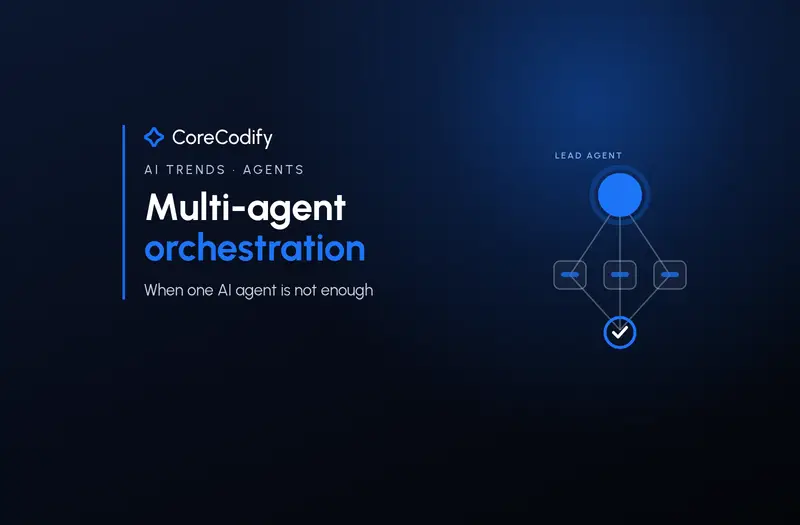
Anthropic's own guide defines a multi-agent system as “an architecture where multiple LLM instances run with separate conversation contexts, coordinated through code.” The most common pattern is an orchestrator, or lead agent, that plans the work and hands well-scoped pieces to subagents. Each subagent works in its own clean context, so a long lookup or a big document does not crowd out the lead agent's reasoning.
Three ideas sit underneath almost every product launched this month: parallel work (many agents covering a large search space at once), specialisation (an agent with a narrow set of tools and instructions, such as a security reviewer), and verification (a separate agent whose only job is to check another agent's output).
What shipped in October 2026
Claude Managed Agents dynamic workflows
On 9 October Anthropic put dynamic workflows for Claude Managed Agents into public beta. Instead of delegating tasks one by one, the lead agent writes a workflow, a program that runs many agents in phases and combines their results, while the server runs it in the background. Anthropic's documentation lists audits, migrations, deep research and cross-checking as typical uses, and Anthropic says Claude can orchestrate up to 1,000 agents per run. In its announcement, Anthropic's developer account reported: “We planted 70 bugs in a 116k-line codebase. Across 3 runs, a single agent found 14, 15 and 27 bugs. A workflow consistently found 66 in each of its 3 runs.” It also warned that workflows “can use a lot of tokens, so we suggest starting with a scoped task.”
Google Cloud Agent Compute Engine
On 22 October at AGNTCon + MCPCon, Google announced Agent Compute Engine, the infrastructure that already runs Gemini's agents, coming to Google Cloud customers in preview in the coming months. Every agent gets its own hardware-isolated microVM that can pause while the agent waits and resume from a snapshot. Google distinguished engineers Rohit Jnagal and Ramanathan Venkatapathy explain the design in a technical deep dive, and The New Stack quoted the team's security principle: “We started from one rule: Assume an attacker controls everything inside the sandbox, and make sure they find nothing there to use.”
AWS Infinity, an open-source agent runtime
On 23 October AWS released Infinity under the Apache 2.0 licence as part of the Hydro project with UC Berkeley. Infinity suspends an agent whenever it calls a tool and resumes it when the result arrives, so waiting agents cost almost nothing. AWS says “we can fit 75,000 concurrent agents in the 8 GB of a Raspberry Pi 5,” and the same mechanism carries messages between parent and child agents. AWS is clear that this is “an early research release”, not a managed service.
Oracle AI Agent Studio for Industry Applications
On 21 October Oracle announced a no-code and low-code environment for building and orchestrating teams of industry agents across its industry and Fusion applications, with MCP support, testing, guardrails and monitoring. Oracle's Simon de Montfort Walker said “AI agents create value when they can work within the processes, data, and controls that define how an industry operates.” Oracle's footnote says the product is planned within the next 12 months in the US.
GitLab agent orchestration
GitLab added goal-driven flows and Custom Flows to its Duo Agent Platform, where one model does the work and a separate model checks progress against the goal, with human checkpoints at sensitive steps. GitLab's Elisabeth Burrows summed up the motivation: “AI coding tools have changed how fast software gets written, but not how fast it ships.”
When one agent is still the better choice
The most useful advice this month comes from a vendor that sells multi-agent tools. Anthropic's guide to building multi-agent systems, written by Cara Phillips, is blunt: “At Anthropic, we've seen teams invest months building elaborate multi-agent architectures only to discover that improved prompting on a single agent achieved equivalent results.”
Cost is the main reason. The same guide says “multi-agent implementations typically use 3-10x more tokens than single-agent approaches for equivalent tasks,” because each agent needs its own context, agents exchange coordination messages, and results must be summarised at every handoff. Parallel agents also do not always finish sooner: the guide says the main benefit of parallelisation is thoroughness, not speed.
Anthropic names three situations where several agents consistently beat one: when a single agent's context gets polluted with information it does not need, when the work splits into genuinely independent pieces, and when specialised tools or instructions improve focus. It also warns against splitting work by job title, such as a planner, a coder, a tester and a reviewer, because each handoff loses context. In one such experiment, the guide says, the subagents spent more tokens on coordination than on the actual work. Its closing advice: “Start with the simplest approach that works, and add complexity only when evidence supports it.”
The new failure modes
More agents also means new ways to fail. In an October 2026 research paper, Why Do Agent Teams Fail Across Boundaries?, AI researchers studied more than 2,500 recorded runs of agents that work for different people or organisations and talk to each other. They found that “no agent verifies a peer's factual claim on its own initiative, so an A2A system inherits the reliability of its least reliable participant unless the protocol or mechanism performs the check.” In other words, if agents simply trust each other, one weak link can quietly spoil the whole result.
Enterprise readiness is lagging too. A survey of 858 executives by OutSystems, CIO Dive and KPMG, published on 15 October, found that 82 percent believe they can keep pace with governing AI agents, but only 26 percent say they are well prepared to resolve conflicts between agents, systems and automated workflows, and just 5 percent have automated controls, audit trails and formal human review points in place. OutSystems CIO Tiago Azevedo said: “Having put agents to work across the business, I've learned that safety comes from building control into the platform, not reviewing it afterward.”
A practical checklist before you add more agents
- Start with one well-prompted agent with good tools, and measure where it actually fails before adding a second.
- Split work by context, not by job title: give one agent a whole feature or document set, rather than handing the same work between a planner, a builder and a tester.
- Use parallel agents for wide, independent work such as researching many sources, auditing many pages or checking many files.
- Add a separate verification step with clear pass and fail criteria, and require agents to check each other's claims rather than trusting them.
- Set a token or cost budget per run, and start with a small, scoped task before scaling up.
- Run agents in sandboxes with short-lived credentials, and keep secrets out of the agent's environment.
- Keep a human approval step for payments, customer data, deployments and anything that cannot be undone.
- Log every agent's actions so you can trace what happened when a result looks wrong.
Where CoreCodify fits
For most small businesses and startups, the right first step is still one reliable AI feature, such as a support assistant, a document reader or a content helper, built into a website or app with proper testing and guardrails. Multi-agent orchestration becomes worth it when that single agent clearly hits its limits, and the platforms launched this month make that next step easier when you get there.
At CoreCodify we design and build websites, mobile apps, UI/UX and AI solutions, and we plan AI features around real constraints such as cost, privacy and review. If you want help deciding whether your product needs one agent or a team of them, and building it properly, hire me for custom work at usamify.com.
Sources
- Claude Platform release notes: dynamic workflows for Claude Managed Agents (Oct 9, 2026)
- Claude Platform docs: Multiagent orchestration
- ClaudeDevs on X: Claude Managed Agents dynamic workflows public beta (Oct 9, 2026)
- ClaudeDevs on X: single agent vs workflow bug-finding test
- ClaudeDevs on X: up to 1,000 agents per run
- ClaudeDevs on X: start with a scoped task
- Claude by Anthropic: Building multi-agent systems: when and how to use them, by Cara Phillips
- Google Cloud Blog: Introducing Agent Compute Engine and expanding agent governance (Oct 22, 2026)
- The New Stack: Google turns the infrastructure behind Gemini's agents into a cloud service, by Frederic Lardinois (Oct 22, 2026)
- AWS Open Source Blog: Introducing Infinity, a runtime for extreme agent concurrency (Oct 23, 2026)
- Oracle: Oracle AI Agent Studio for Industry Applications helps accelerate business outcomes (Oct 21, 2026)
- GitLab Blog: Introducing GitLab's agent orchestration for software development, by Elisabeth Burrows (Oct 13, 2026)
- arXiv: Why Do Agent Teams Fail Across Boundaries? A Failure Taxonomy for Agent-to-Agent Systems with Private States (Oct 2026)
- OutSystems: The Agentic AI Era Is Here, Enterprise Readiness Is Not, New OutSystems Research Finds (Oct 15, 2026)